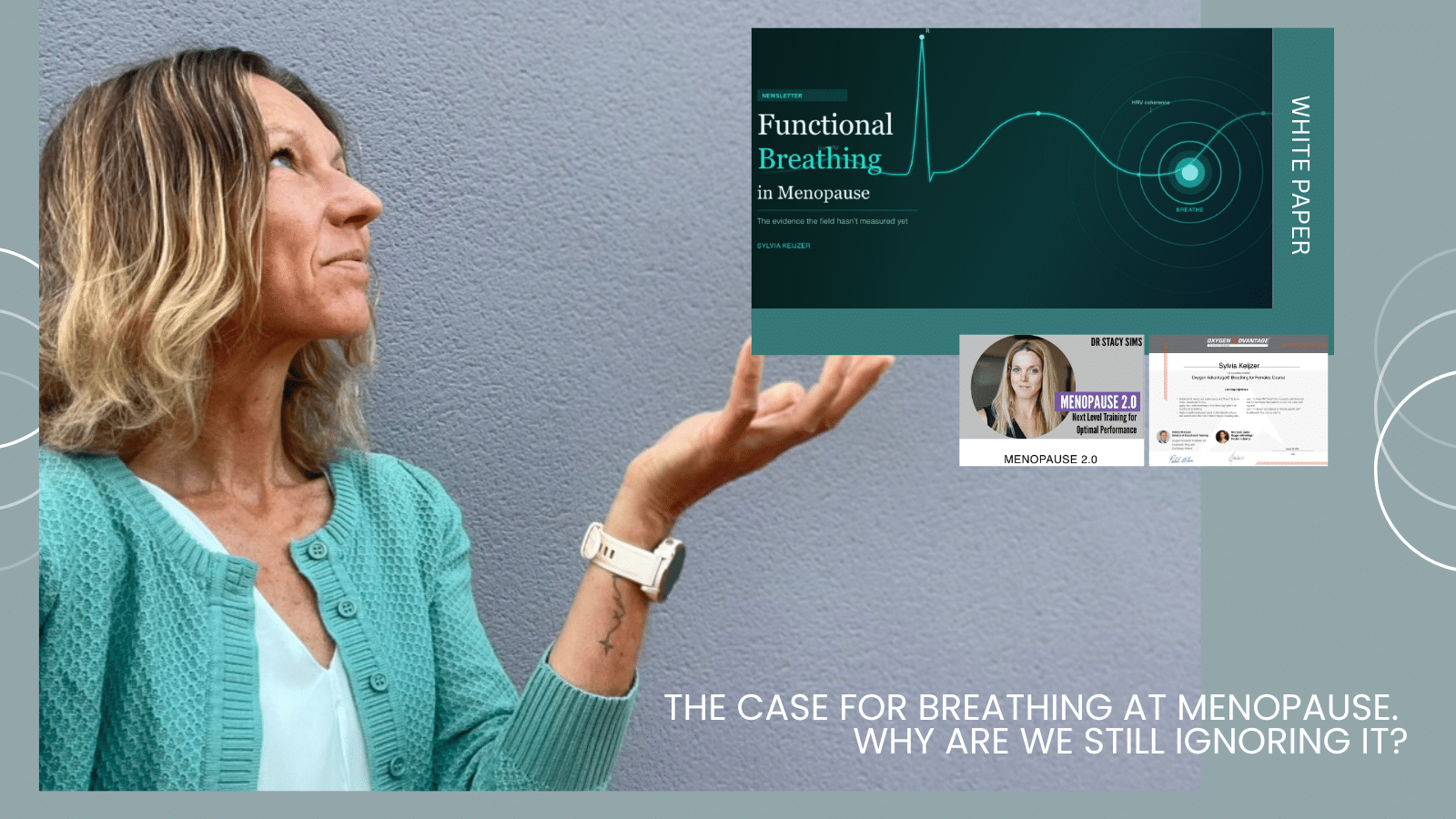
I have spent years in pharmaceutical Women’s Health, including in the menopause space. And there is a pattern I keep seeing. When we talk about supporting women through perimenopause, menopause and post menopause, the same toolkit appears again and again: hormones, nutrition, sleep hygiene, movement and at worst, “learn to live with it.”
All of these matter. They are evidence-based. They are part of the picture.
But something is still missing.
There is one intervention that targets a core mechanism underlying many menopausal symptoms: autonomic nervous system regulation. It is measurable. It is free. And it can shift physiological state within a single session. And yet it is almost entirely absent from clinical menopause conversations.
What menopause actually does to your nervous system
Menopause is often reduced into a hormones story. Which, rightly said, it is.
Although, the downstream effect of declining oestrogen on the autonomic nervous system (ANS) is where much of the lived experience comes from.
As oestrogen falls, the balance between your sympathetic (‘fight or flight’) and parasympathetic (‘rest and regulate’) nervous systems shifts. Sympathetic activity rises. Parasympathetic tone, driven primarily by the vagus nerve, declines.
The result is a nervous system running hotter than it should. Hot flushes. Disrupted sleep. A lower threshold for anxiety. A heart that is less able to adapt and recover.
You can measure this shift directly through Heart rate variability (HRV). While not a direct measure, HRV is one of the most widely used non-invasive indicators of parasympathetic (vagal) activity. And the research is very clear and supportive about that.
- Women with moderate-to-severe menopausal symptoms had significantly lower HRV than women with mild symptoms. Lower HRV, meaning lower vagal activity, was independently associated with hot flushes, poor sleep, and psychological distress.
- Postmenopausal status and low oestradiol were independently associated with reduced HRV, confirming that oestrogen withdrawal drives vagal withdrawal.
- ANS dysregulation throughout the menopausal transition is now proposed as a unifying mechanism behind cardiovascular risk, cognitive changes, and the full constellation of menopausal symptoms.
If autonomic dysregulation, and specifically reduced vagal tone, is a key driver behind many menopausal symptoms, then the real question is: what is the most direct way to restore it?
Functional Breathing
Because it’s one of the few functions that sits at the intersection of voluntary control and autonomic regulation.
The vagus nerve runs from the brainstem through the body. It regulates heart rate, breathing, digestion and the stress response. And unlike most of the autonomic nervous system, the vagus nerve is directly accessible through one voluntary act: your breath.
When you slow your breathing to around 5–6 cycles per minute, also called coherent breathing, you start to align respiration with heart rate dynamics. Baroreflex sensitivity improves. Vagal activity increases. HRV rises. The nervous system shifts.
This is not speculative. The physiology is well understood, and the body of clinical evidence continues to grow.
- Systematic review and meta-analysis: voluntary slow breathing consistently increased vagally mediated HRV during sessions, immediately after, and after multi-session training. The effect was robust across populations and settings.
- Optimal cardiac vagal activation occurred at 5–7 breaths per minute. Breathing at an individual’s resonance frequency, typically 4.5–6.5 bpm produced the greatest HRV amplification through baroreflex synchronisation.
- Slow breathing and HRV biofeedback are effective, non-invasive tools to improve vagal tone, stress resilience and cardiovascular health. Effects are consistent across chronic conditions and healthy populations.
What it actually changes, the outcomes that matter
The reason I keep coming back to functional breathing in menopause is not just the mechanism. It’s what shifts when HRV improves. And these are exactly the outcomes women and their clinicians are trying to fix.
And yet… almost no one is talking about it.
- Sleep
40–60% of menopausal women struggle with sleep. Not just because of hormones but because the nervous system stays in overdrive.
The same sympathetic activation behind hot flushes also disrupts sleep onset and quality.Shift the autonomic balance, and you change the conditions for sleep.
That’s exactly what functional breathing does.
Recent meta-analyses show that non-pharmacological interventions targeting autonomic regulation significantly improve sleep quality in peri- and postmenopausal women. The strongest effects? Practices that include breathing.
- Around 1 in 2 women in perimenopause experience anxiety. This is not just psychological. It’s physiological.
Elevated sympathetic tone. Reduced vagal brake. A system that reacts faster and recovers slower. Breathing directly targets that loop. Not only acutely, within minutes. But structurally, with consistent practice.
A recent systematic review shows that just a few minutes of slow breathing, practised regularly, leads to meaningful reductions in both physiological and perceived anxiety.
- Mood / Depression
During the menopausal transition, the risk of depression doubles, sometimes triples.
And again, the pattern shows up in the physiology. Lower HRV is consistently associated with poorer mood regulation. When you improve vagal function, you’re not just “relaxing.” You’re influencing the system that underpins emotional stability.
Recent meta-analyses show that mind-body interventions combining breathing and movement significantly reduce depressive symptoms often outperforming general exercise when it comes to psychological outcomes.
What the guidelines actually say, and why it matters
I want to be precise here, because this is where it gets interesting. When you look at major clinical guidelines for menopause management, functional breathing is not a core recommendation. And, the reality is more nuanced than “it doesn’t work.”
That nuance matters.
Both the North American Menopause Society (2023) and the European Menopause and Andropause Society have evaluated paced or slow breathing interventions.
Their conclusion: not recommended for vasomotor symptoms. And, here is the key detail:They evaluated it almost exclusively against one outcome, hot flush frequency. And for that specific endpoint, paced breathing does not consistently outperform control conditions.
But it is also incomplete. Because hot flushes are not where the strongest physiological signal for breathing appears.
No major guideline has yet systematically evaluated slow breathing in relation to:
- heart rate variability (HRV)
- sleep quality
- anxiety regulation
- depressive symptoms
- autonomic nervous system balance
in menopausal populations. That gap is still open.
The most recent guidance from the National Institute for Health and Care Excellence (2024) does not include breathing at all.
The Dutch Nederlandse Vereniging voor Obstetrie en Gynaecologie references relaxation techniques in general lifestyle advice, but without specific physiological recommendations. The Dutch guideline largely aligns with NICE.
Where the field is starting to shift is in the International Menopause Society 2025 White Paper on Lifestyle Medicine in Menopausal Health, which explicitly includes deep breathing as a supportive tool for stress regulation and wellbeing.
That is an important signal, but it has not yet translated into clinical practice guidelines.
So the gap is not that breathing has never been considered. The gap is that it has been evaluated against a narrow outcome.
A relevant question might be “What does functional breathing do to the autonomic nervous system itself?” That is the gap worth addressing. And it is increasingly measurable.
With modern HRV tracking through wearable technology, women can now observe physiological changes in real time. A simple breathing practice can show immediate shifts in HRV and longer-term changes in recovery patterns.
For the first time, the feedback loop is not theoretical.
It is visible. Evidently, you feel it also! But seeing, is believing. Once physiology becomes visible, it becomes actionable.
This topic is personal
As a 52-year-old woman in transition and someone who has spent decades working in women’s health and behaviour change, I see a clear gap between evidence, lived experience and what is actually being discussed in menopause care.
That gap is where this conversation belongs.
Especially now, as pharmaceutical approaches and wellbeing wearables are moving closer together, but often still missing the nervous system layer in between.
My aim is simple: To bring something evidence-based, immediately applicable and measurable into the menopause conversation.
Functional breathing is one of those levers. In menopause. It’s time we talk about it.